Use 又 to report that an event happened again
A repeated event can be a useful topic for a short update: a person came again, a familiar problem returned or someone chose the same activity. Practise 又 in a fictional past-event report, then compare repetition with a one-time occurrence.
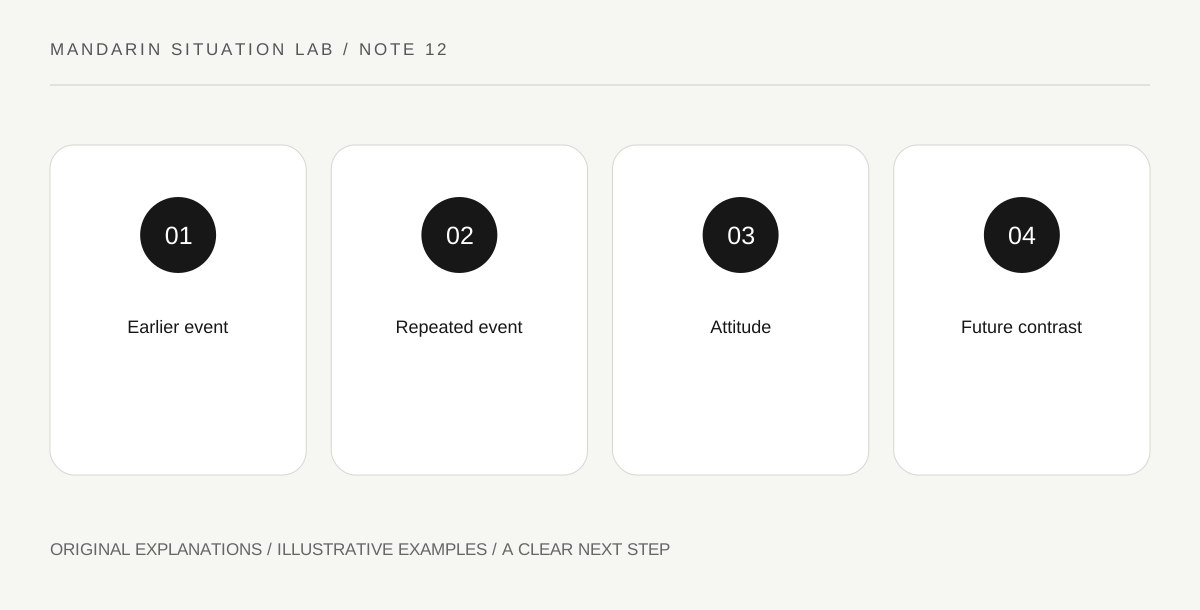
Original explanatory diagram. Read the full method and limitations below.
Make the earlier event visible
A worksheet shows a visitor at a club on Monday and the same visitor there on Thursday. The earlier visit makes again meaningful. 他又来了。Tā yòu lái le. He came again. Without any shared or implied earlier event, the listener may wonder what is repeating. You do not need to narrate the entire first visit, but the scenario should supply enough context for 又 to have a clear job.
Place 又 before the action
In 又来了, 又 comes before 来. Keep the small group together while speaking, then add the subject. Try 我又忘了, wǒ yòu wàng le, I forgot again, in a harmless invented reminder task. The word does not itself tell the listener everything about time, cause or frequency. It signals recurrence in these examples. Add a time word only when the exercise requires distinguishing today from a previous occasion.
Keep the tone separate from the repetition
Again can express annoyance, delight or a neutral observation depending on context and delivery. 又 does not require a complaint. A friend coming again may be welcome; an overlooked practice note may be inconvenient. In the role-play, give the speaker an emotion card and let the partner infer the attitude from the complete utterance. Avoid claiming that one tone pattern always expresses the same feeling across all speakers.
Contrast a report with a future plan
我明天再来, wǒ míngtiān zài lái, I will come again tomorrow, uses a different word in this prospective example. Keep this contrast tied to the two scenarios: the worksheet reports a repeat that happened, while the other card proposes another visit. Do not substitute 又 and 再 mechanically based only on the English word again. Explain the intended time and event first, then choose the phrase that fits the scenario.
Illustrative worked example
Illustrative task: A fictional club visitor appears in two dated pictures. The learner reports 他又来了. The partner chooses whether the speaker sounds pleased, neutral or frustrated from a matching attitude card. Next, the pictures are replaced by a tomorrow plan, and the learner says 我明天再来. A listener explains which sentence reports an actual repeated arrival and which proposes a later return. The practice uses the same action to expose the different time relationship.
Questions that come up
Does 又 always describe the past?
Its full uses are broader than this beginner contrast. This lesson focuses on a common report of recurrence and compares it with a future repetition using 再.
Must I sound annoyed when saying again?
No. The surrounding situation and delivery shape the attitude. Practise a welcome repeated visit as well as a mildly inconvenient repeated mistake.
References and scope
These sources support the factual background. Examples and exercises are original illustrative teaching material. References do not imply endorsement.
- Mango Languages: Using you for again — Repeated events with you.
- Mango Languages: Using zai for again — Prospective repetition with zai.