Ask about a previous experience without asking when it happened
Have you ever tried a craft, visited a place or watched a performance? Mandarin 过 can help present an experience as something in a person’s background. Practise asking about the experience first, then choosing a follow-up that fits the answer.
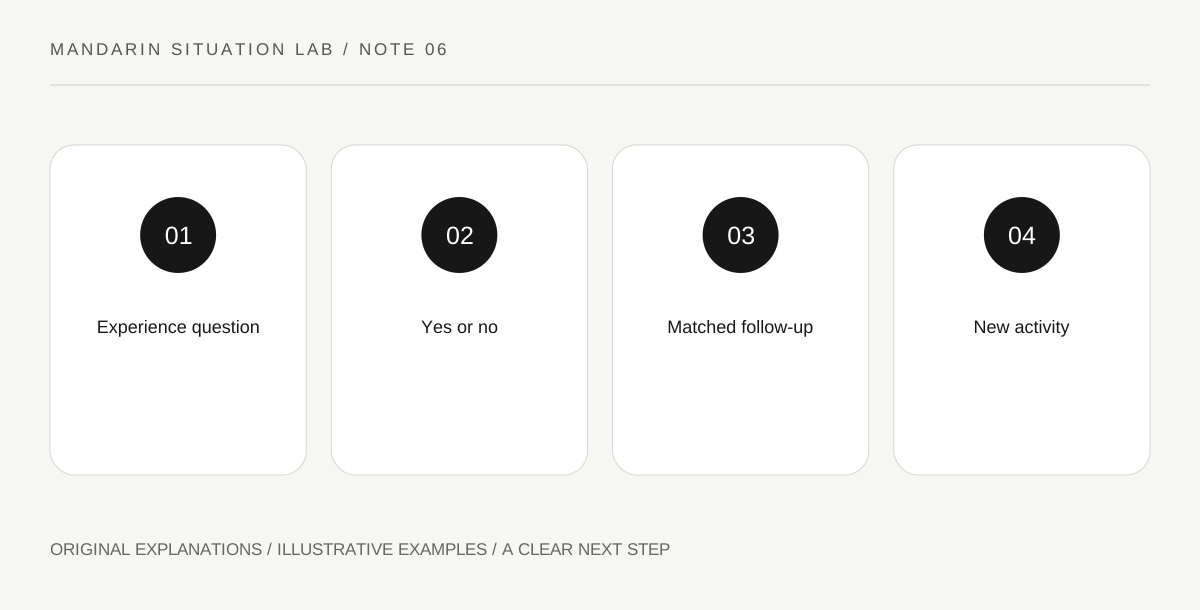
Original explanatory diagram. Read the full method and limitations below.
Keep the question about experience
你做过陶器吗?Nǐ zuòguo táoqì ma? asks whether the person has made pottery before. The focus is the existence of that experience, rather than its exact date. Put a small experience card beside a fictional person’s name. The card can be present or absent. Your partner answers according to the card, making the question meaningful instead of assuming that every practice answer should be affirmative.
Place 过 after the action verb
In 做过陶器, 过 follows 做. Keep the verb and particle together while reading, then include the object. Do not put 过 at the front because the English question begins Have you ever. Mandarin does not need to copy that English order. A few familiar activity phrases are enough for the first round. The small vocabulary set lets you focus on the experience pattern rather than searching for several new nouns.
Answer with the same event in view
做过, zuòguo, can answer affirmatively in context. 没做过, méi zuòguo, gives the negative response for this example. You can also use a complete sentence: 我没做过陶器. The negative does not require changing the activity or inventing a future intention. Practise hearing both possible answers. A partner should be free to say no, which creates a different but equally valid next turn in the conversation.
Choose a follow-up from the answer
After yes, ask 好玩吗?Hǎowán ma? Was it enjoyable? After no, you might ask 想试试吗?Xiǎng shìshi ma? Would you like to try? These responses show that you listened. Avoid asking where it happened immediately after the person says it never happened. In the final role-play, use a new harmless activity and let the partner choose their answer secretly, so you must adapt your next line rather than recite one fixed dialogue.
Illustrative worked example
Illustrative exchange: One learner asks 你做过陶器吗? The partner has a no-experience card and answers 没做过. The learner follows with 想试试吗? In the second round, the partner holds an experience card and answers 做过. The learner asks 好玩吗? A listener explains in English which response led to which follow-up. No participant claims the fictional activity as a real personal experience unless they choose to discuss their own history.
Questions that come up
Is 过 just the Mandarin past tense?
No. Here it marks previous experience. Mandarin expresses time and aspect through several resources, and 过 should not be added automatically to every event in an English past-tense sentence.
Must I say an exact date?
No. The experience question does not demand one. A later question can ask when it happened if that detail is relevant and the person wishes to share it.
References and scope
These sources support the factual background. Examples and exercises are original illustrative teaching material. References do not imply endorsement.
- Mango Languages: Aspectual particles le and guo — Completed actions and previous experience.