Say what is happening now with an action in progress
A question about what someone is doing now asks for a current action rather than a usual habit. Practise using 在 before an action, then add a brief follow-up that explains whether the person can respond immediately. Use ordinary fictional activities for the exercise.
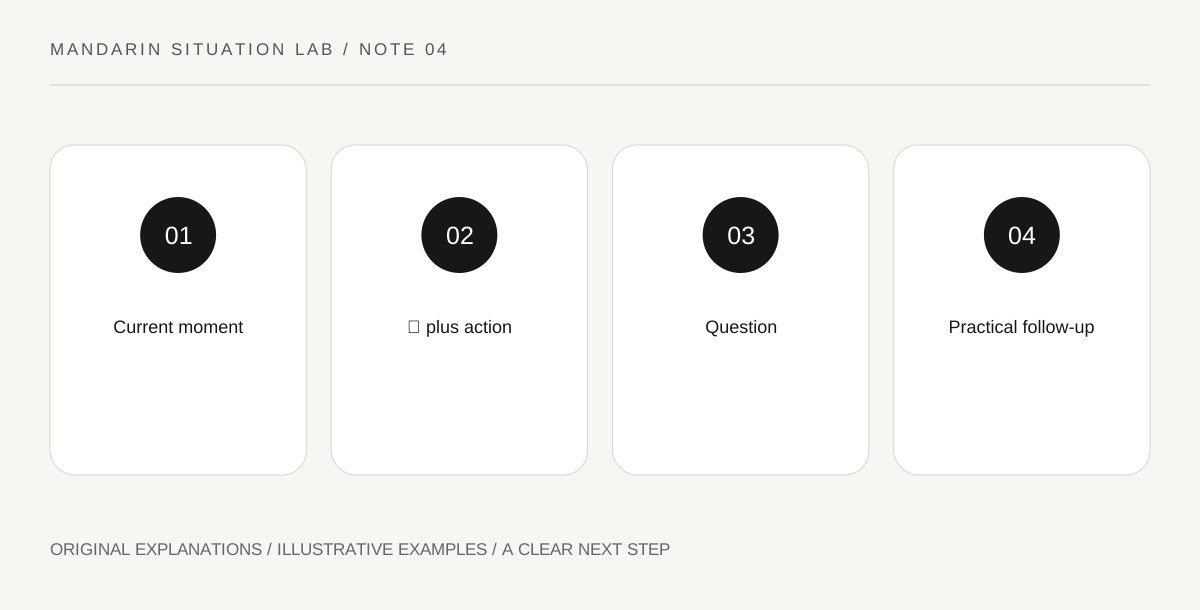
Original explanatory diagram. Read the full method and limitations below.
Distinguish today’s action from a habit
我看书 can describe reading in a suitable context, while 我在看书, wǒ zài kàn shū, explicitly presents reading as in progress in this exercise. Imagine a still picture of someone with an open book. You are describing what they are doing at that moment, not how often they read. Keeping the visual moment fixed helps you hear the function of 在 without relying only on an English translation.
Place 在 before the action
我在做饭。Wǒ zài zuò fàn. I am cooking. 我在写邮件。Wǒ zài xiě yóujiàn. I am writing an email. Keep the subject, 在 and action in that order for these examples. Do not append 在 after the verb as though it were an English ending. Practise with three picture cards and let a partner choose the card before you speak, so the activity changes while the pattern remains available.
Ask about the current activity
你在做什么?Nǐ zài zuò shénme? means What are you doing? The question word stays where the unknown information belongs. Respond with a whole current-action sentence at first. Then switch roles and let the partner answer with an unfamiliar but simple activity. Your listening task is to identify the activity rather than inspect every word. Ask a focused clarification if the action itself is the missing piece. A picture-matching answer is enough for this round; exact transcription is a separate task.
Add a practical response boundary
我在做饭,等一下。Wǒ zài zuò fàn, děng yíxià. I am cooking; wait a moment. The follow-up explains why the person may not respond immediately. In a role-play, use a harmless pretend action rather than multitasking during something that needs attention. The language task is to connect an ongoing action with a clear response, then return to the conversation when the fictional activity ends.
Illustrative worked example
Illustrative phone scene: Mei calls a friend in a worksheet dialogue. The friend says 我在写邮件, meaning I am writing an email. Mei asks whether the friend can talk a little later. In the next round, the activity card changes to 做饭, and the learner produces 我在做饭,等一下. The partner points to the matching picture and explains in English why an immediate long conversation may be inconvenient.
Questions that come up
Does 在 always mark an ongoing action?
No. 在 has other uses, including location. This exercise focuses on 在 before an action such as writing or cooking, where it marks the action in progress.
Should I add 正在 instead?
正在 can also emphasize an action in progress in suitable contexts. Begin with 在 in these short examples and add other patterns as your study develops.
References and scope
These sources support the factual background. Examples and exercises are original illustrative teaching material. References do not imply endorsement.
- Mango Languages: How to use the aspectual particles zhe and zai — Actions in progress with zai before a verb.