Separate borrowing a book from giving it back
A library conversation contains two directions: taking a book temporarily and returning it later. Practise the verbs inside a short exchange with a clear object and deadline. The activity uses an invented library, so its loan period is a language example rather than a real policy.
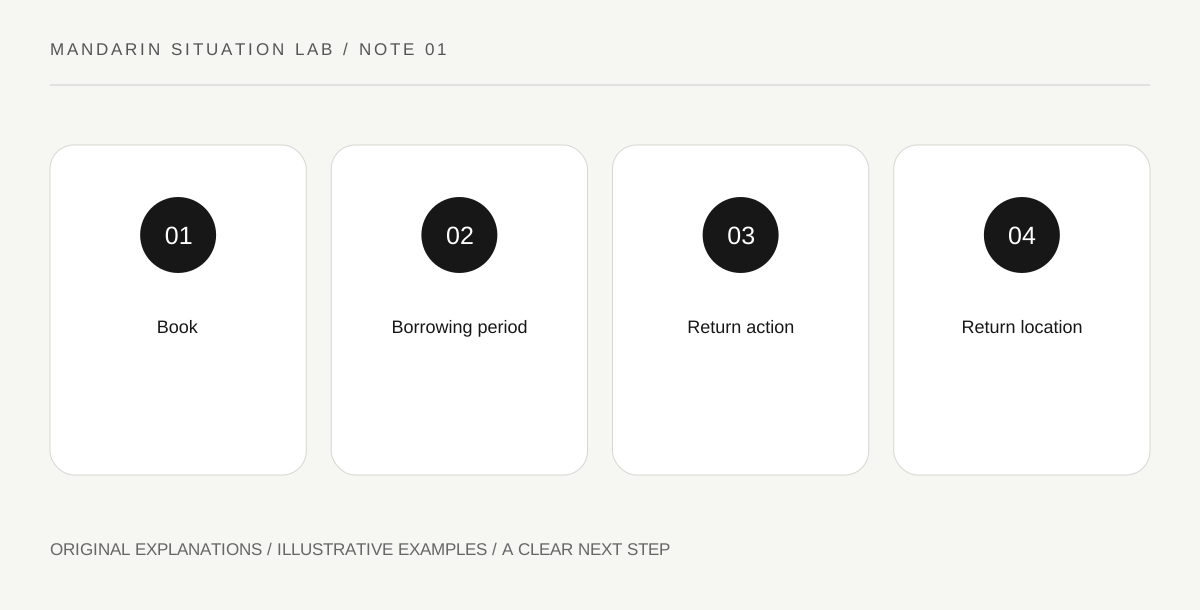
Original explanatory diagram. Read the full method and limitations below.
Name the object and intended action
我想借这本书。Wǒ xiǎng jiè zhè běn shū. This means I would like to borrow this book. Keep 这本书 together as this book, with 本 as the classifier in this phrase. Point to a practice book or picture while saying the sentence. Then remove the pointing and add a title from your fictional worksheet so the listener can identify the book from language alone.
Ask about the loan period
可以借多久?Kěyǐ jiè duō jiǔ? asks How long can I borrow it? The answer might be 两个星期, liǎng ge xīngqī, two weeks, in this invented exercise. Do not memorize that duration as a universal library rule. Have your partner choose among three fictional loan periods. You must listen for the duration rather than assume the answer from the script, then say it back in your own short response. Make a second library card with a different duration. The learner should ask again and update the return plan, rather than carrying the first fictional policy into the new conversation.
Use a different verb for the return
我星期五还书。Wǒ xīngqīwǔ huán shū. I will return the book on Friday. In this meaning, 还 is pronounced huán, not hái. Keeping the word inside 还书 helps connect pronunciation and action. Draw an arrow from the library to the learner for 借 and a second arrow back for 还. The direction of the object changes while the same book remains in the story.
Practise a complete closing question
我可以在这里还书吗?Wǒ kěyǐ zài zhèlǐ huán shū ma? asks whether you may return the book here. Your partner can answer yes or point to a different fictional desk. The exercise ends when you can say what you are borrowing, how long the loan lasts and where the return happens. Those three outcomes give the practice a purpose beyond producing an isolated correct verb.
Illustrative worked example
Illustrative exchange: A learner chooses a fictional novel and says 我想借这本书, followed by 可以借多久? The partner answers 两个星期 and indicates a returns desk on a drawing. The learner repeats 两个星期 and asks whether that desk is the return location. After switching roles, the new librarian changes the loan period to one week. Both learners draw arrows to show when the book leaves and when it comes back.
Questions that come up
Does 借 always mean borrow?
Its direction depends on the construction and context. This lesson uses 我借这本书 as a borrower’s request; lending can be expressed with additional recipient information, such as 借给.
Can I omit the title while pointing?
Often the shared context identifies the book. Practise once with pointing and once without it so you learn when language must carry more identifying information.
References and scope
These sources support the factual background. Examples and exercises are original illustrative teaching material. References do not imply endorsement.
- Mango Languages: How do measure words work in Mandarin Chinese? — Number-classifier-noun combinations.
- Mango Languages: Using gei — Recipient and giving constructions.
- Mango Languages: Expressing ability — Hui, neng and keyi distinctions.