Put two errands in an order with 先 and 再
An order of actions can matter even when both actions are familiar. Practise a short plan using first and then, with two harmless errands on a fictional map. The goal is to communicate the sequence clearly enough that a partner can arrange the cards correctly.
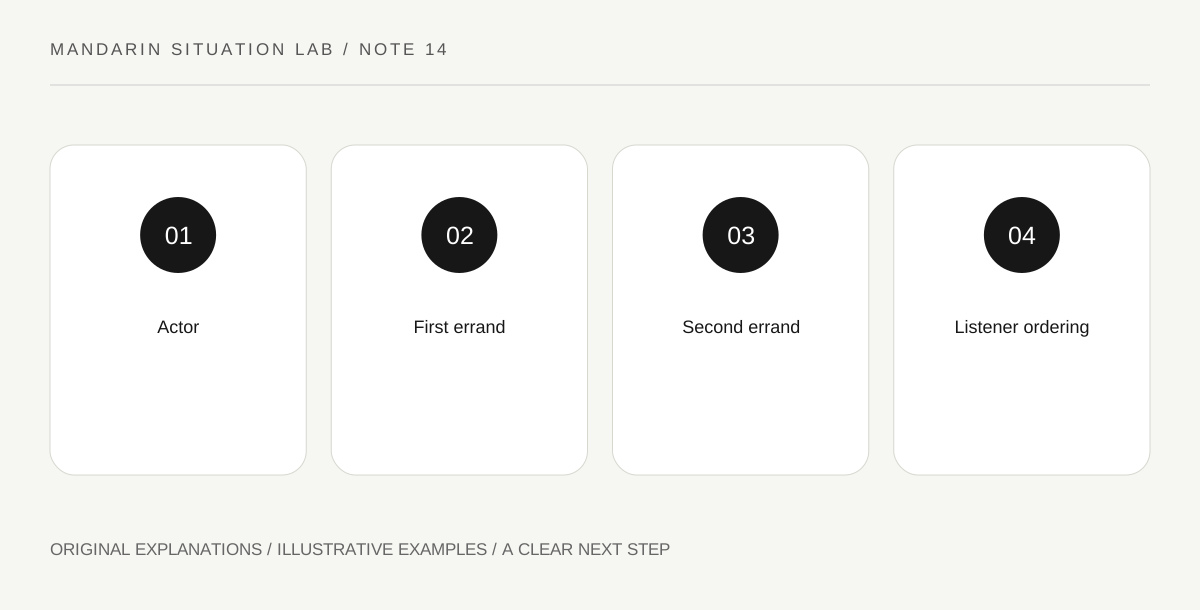
Original explanatory diagram. Read the full method and limitations below.
Choose two actions that can be reordered
The worksheet contains returning a book and buying fruit. Both actions are ordinary, but the fictional plan requires one before the other. 我们先还书,再买水果。Wǒmen xiān huán shū, zài mǎi shuǐguǒ. We will return the books first, then buy fruit. The words 先 and 再 mark the order. Do not begin by translating every English and as 和, because joining actions has its own patterns.
Keep the actor consistent
In this sentence, 我们 remains the actor for both actions. If a different person performs the second task, the plan may need another subject and more explicit wording. Begin with one actor so you can focus on sequence. Have your partner point to who performs each action on the worksheet. An accurate order is still incomplete if the listener thinks a different person is responsible for the second errand.
Reverse the plan deliberately
我们先买水果,再还书 reverses the order. The same vocabulary now describes a different sequence. Move the two picture cards while saying the sentence, then ask your partner to arrange another set without watching your hands. This checks whether the language itself communicates the order. If the partner reverses the cards, identify which marker they missed before repeating the whole sentence more quickly or adding unrelated detail.
Add a reason only after the sequence is clear
You might explain in English during early practice that the fictional library closes sooner, then later learn an appropriate Mandarin reason sentence. Do not invent real opening hours for a named place. The task remains useful with a simple invented constraint. Finish by having the listener state the first action and point to the second. The plan is complete when both speakers agree on the order, not when the sentence has become long.
Illustrative worked example
Illustrative map task: A fictional library and fruit stall appear on a worksheet. The learner’s card says to return the book before buying fruit. They say 我们先还书,再买水果. The partner places the library card first. A second card reverses the order, so the learner must change the sentence. The pair then explains why 和 between two nouns does not automatically supply the first-then relationship between these two actions.
Questions that come up
Does 再 always mean again?
No. In this sequence, 再 helps introduce the subsequent action. A word can have related uses that need to be learned through complete examples.
Can I join these actions with 和?
和 commonly joins nouns, but it is not an automatic equivalent of English and between action clauses. Use the first-then pattern practised here for the intended sequence.
References and scope
These sources support the factual background. Examples and exercises are original illustrative teaching material. References do not imply endorsement.
- Mango Languages: Using zai for again — Prospective repetition with zai.
- Mango Languages: Serial verb constructions — Shared-subject actions and destination-purpose constructions.
- Mango Languages: Ways to say and — Different connections for nouns and actions.