Match an owner to an object with 的
A table of similar objects creates a useful possession task: which object belongs to whom? Practise a name plus 的 plus an object, then ask a confirmation question. Use fictional names and belongings so the language can be rehearsed without exposing personal information.
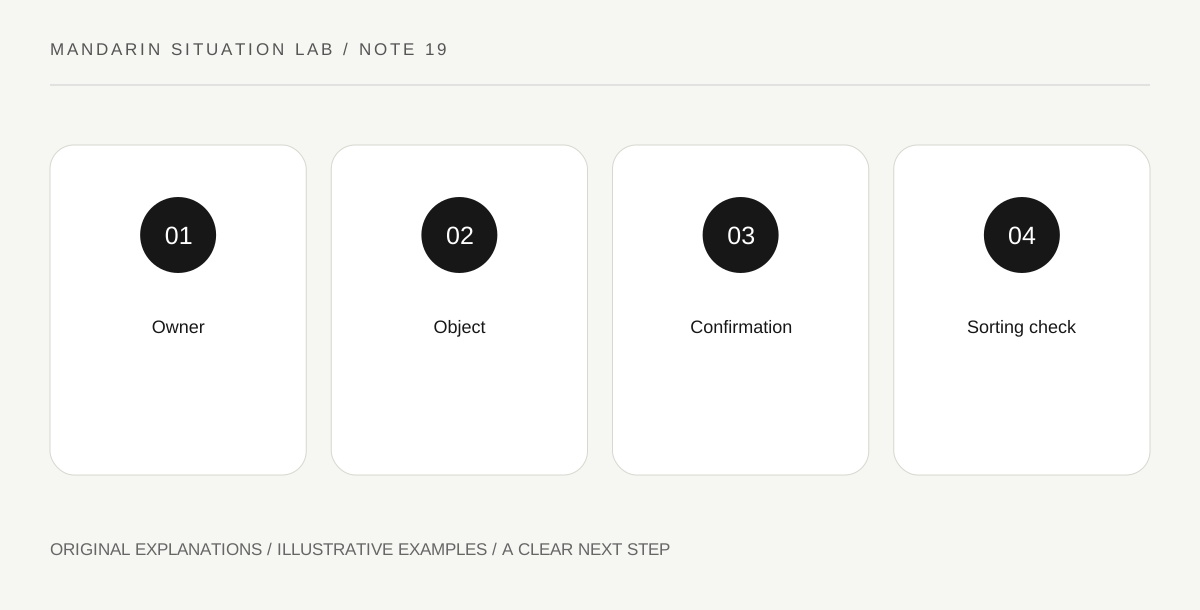
Original explanatory diagram. Read the full method and limitations below.
Build the owner phrase as a unit
小林的杯子, Xiǎolín de bēizi, means Xiaolin’s cup. The owner appears before 的 and the object follows. Arrange three cards labeled owner, 的 and object. This makes the relationship visible before you place the phrase inside a longer sentence. Do not translate the English apostrophe as a separate sound or move the owner’s name after the cup simply because another language expresses possession differently.
Turn the phrase into an identification
这是小林的杯子。Zhè shì Xiǎolín de bēizi. This is Xiaolin’s cup. The sentence identifies the object on the table. Pointing can support the first round, but the partner should still hear whose cup it is. Use two cups with different owner cards and switch their positions. If the learner follows the old position rather than the new owner label, slow down and rebuild the phrase from the meaning.
Ask whether the owner is correct
这是你的杯子吗?Zhè shì nǐ de bēizi ma? Is this your cup? The question invites confirmation or correction. A partner can answer 不是, bú shì, no, it is not, then identify the fictional owner. Do not make every object belong to the listener; the exercise becomes more useful when the learner must understand a correction. A wrong guess is an opportunity to practise repairing the relationship between owner and object.
Shorten only when the object is understood
是我的, shì wǒ de, it is mine, can be enough after the cup has been established. The omitted noun remains recoverable from context. If cups and notebooks are both under discussion, add the noun back when needed. Finish with a sorting task: the listener places each object beside its owner card using only spoken information. The resulting arrangement gives both learners a concrete way to check the communication.
Illustrative worked example
Illustrative sorting task: The table has two cup pictures and one notebook picture. The learner identifies one cup as 小林的杯子 and asks whether another is the partner’s. The partner follows a hidden owner card and answers 不是 before naming the fictional owner. After all objects are placed, the pair compares the arrangement with an answer sheet. They then practise 是我的 only in a round where the object category is already clear.
Questions that come up
Can 的 be omitted in every possessive phrase?
No. Some close relationships allow different patterns, but that does not justify dropping it everywhere. Keep 的 in these owner-and-object examples.
Is 我的 always a complete sentence?
It can serve as a short answer in a clear context. For initial practice, use 是我的 or the full identification so the intended meaning remains easy to follow.
References and scope
These sources support the factual background. Examples and exercises are original illustrative teaching material. References do not imply endorsement.
- Mango Languages: Structural de — Possession, modifiers and recoverable omitted nouns.