Count shirts and trousers at a fictional laundry counter
A laundry exchange makes classifiers useful because the listener must match words to actual pieces of clothing. Practise a small set of garments, count them and confirm which item a question concerns. The goal is an accurate handover in an invented service scenario.
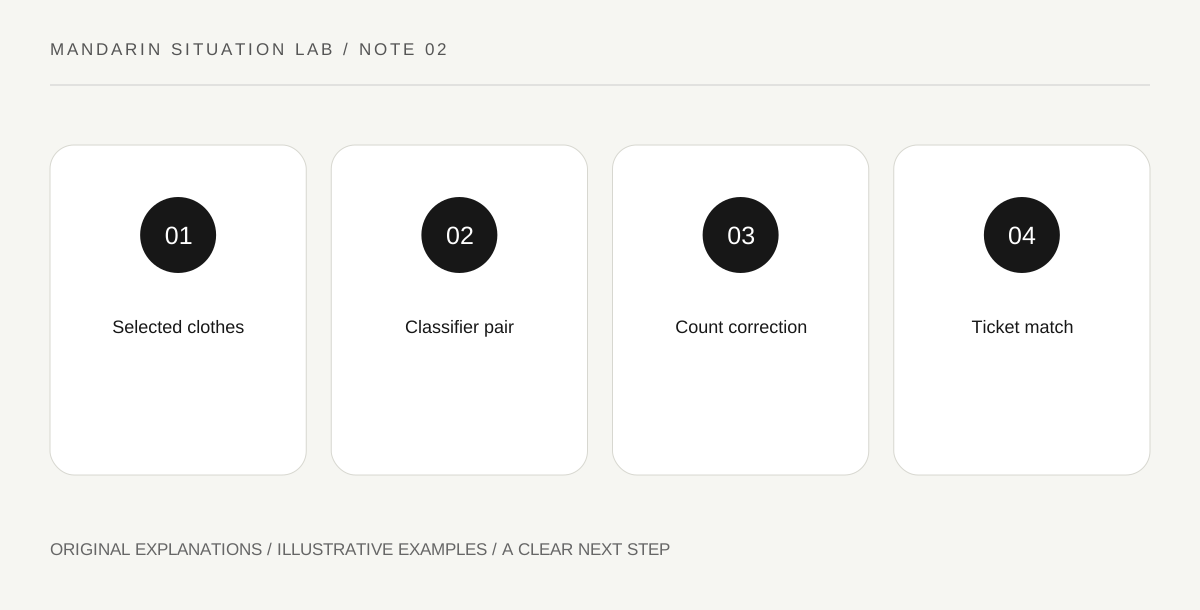
Original explanatory diagram. Read the full method and limitations below.
Keep each noun with its classifier
Use 一件衬衫, yí jiàn chènshān, one shirt, and 一条裤子, yì tiáo kùzi, one pair of trousers. English calls trousers a pair, but this Mandarin phrase uses 条. Learn the complete phrase with a picture rather than translating each English word separately. In pinyin practice, the pronunciation of 一 changes with the following tone; listen to a reliable model while keeping the written character unchanged. Fold a paper shirt card if useful, but keep the garment picture recognizable. The classifier exercise concerns the item being counted, not the size or shape of the card used to represent it.
Count visible items before speaking
Place two shirt cards and one trousers card on a table. Say 两件衬衫,一条裤子。Liǎng jiàn chènshān, yì tiáo kùzi. The quantities should match the cards, not a memorized line. Ask a partner to remove one card secretly and count again. This turns the sentence into a task with a visible answer, helping you notice whether you remembered both the number and the matching classifier.
Use the classifier to identify a question
哪件衬衫?Nǎ jiàn chènshān? means Which shirt? 哪条裤子?Nǎ tiáo kùzi? means Which pair of trousers? A partner can ask one of these questions while you choose a card by color or position. You do not need a large clothing vocabulary for the first round. A small set lets you concentrate on how the classifier remains part of the identifying phrase.
Confirm the whole count before ending
两件衬衫和一条裤子,对吗?Liǎng jiàn chènshān hé yì tiáo kùzi, duì ma? asks for confirmation of the complete set. Listen for a correction rather than assuming that 对 is the only possible answer. In the exercise, the clerk can deliberately change one number, and the customer should correct that number while preserving the other items. Finish by matching the spoken count to a fictional written ticket.
Illustrative worked example
Illustrative practice: The worksheet shows two shirts, one pair of trousers and a scarf that is not part of the handover. The learner states 两件衬衫,一条裤子. The partner deliberately repeats 一件衬衫. The learner points to the two shirt cards and corrects 两件衬衫. They then match the final statement to a practice ticket with no real name, price or service promise attached.
Questions that come up
Can I use 个 for everything while learning?
It may sometimes be understood, but this exercise deliberately builds common noun-classifier pairs. Rehearse the complete pair so you do not need to choose from scratch every time.
Why use 两 rather than 二 here?
两 is the ordinary choice before these classifiers when counting two items. Learn 两件 and 两条 as chunks for this task.
References and scope
These sources support the factual background. Examples and exercises are original illustrative teaching material. References do not imply endorsement.
- Mango Languages: How do measure words work in Mandarin Chinese? — Number-classifier-noun combinations.