Report a task as finished with a result complement
Starting a task and finishing it are different pieces of information. Practise using 完 after a verb to make a completed result visible, then explain what can happen next. The examples concern an invented reading and message task rather than a real work obligation.
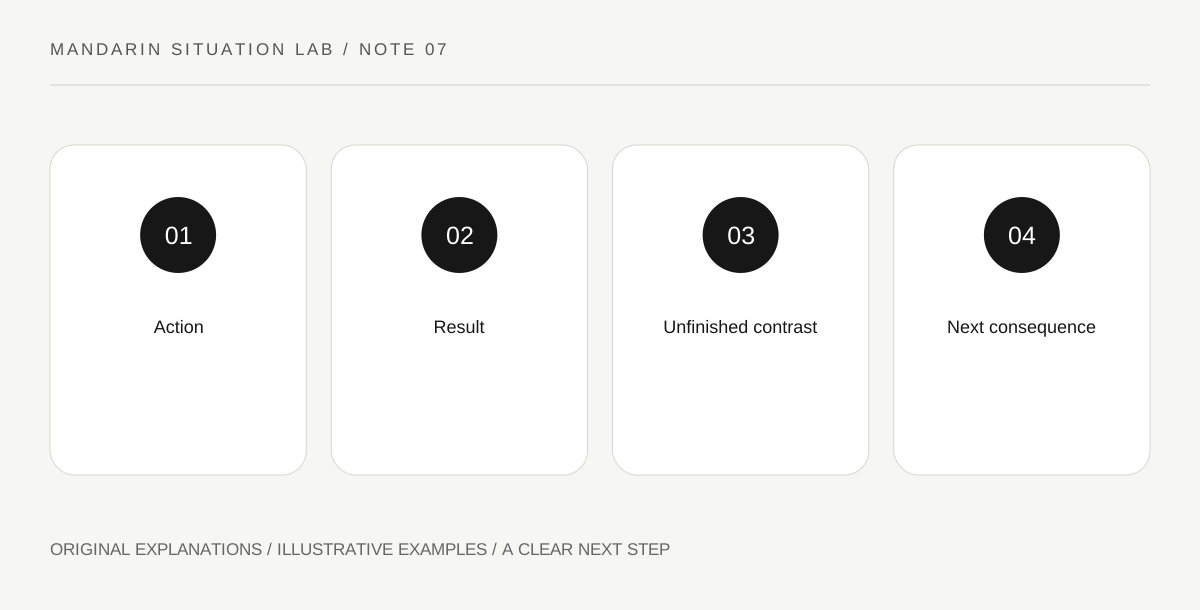
Original explanatory diagram. Read the full method and limitations below.
Identify the action and its endpoint
看书 names reading a book. 看完 adds the result of finishing the relevant reading. In 我看完了, wǒ kànwán le, the context can identify what was read. For the first exercise, place a short fictional text beside a completed checkbox. You are reporting the endpoint, not simply that reading occurred for a while. A partner should be able to distinguish the finished card from a card showing a person still reading.
Keep the result attached to the verb
Write 看 and 完 on separate cards, then bring them together as 看完. The result element follows the action in this compound. Try 写完, xiěwán, finish writing, with a different practice task. Do not assume every English adjective or result can be inserted after every verb. Learn reliable combinations with their intended meanings, and expand the set gradually through a teacher or appropriate grammar resource.
Use an unfinished contrast
我还没写完。Wǒ hái méi xiěwán. I have not finished writing yet. This sentence leaves room for work that has started but remains incomplete. Place an unfinished draft card beside the sentence. Compare it with 我写完了, I have finished writing, in the same fictional scenario. The contrast is useful in a handover because the next person needs to know whether the document is ready, not merely whether you spent time on it.
Connect the result to a next action
我写完了,可以发给你。Wǒ xiěwán le, kěyǐ fā gěi nǐ. I have finished writing it; I can send it to you. The second clause gives the completion a practical consequence. In the exercise, the learner chooses whether the next step is available based on the task card. Avoid treating every finished action as permission to do anything; keep the consequence realistic for the harmless fictional task.
Illustrative worked example
Illustrative handover: A worksheet contains one complete draft and one unfinished draft. The learner holding the complete draft says 我写完了 and offers to send it. The learner holding the unfinished draft says 我还没写完. The recipient chooses which draft can be used in the next practice step. After switching cards, both learners must change their sentence, showing that they are reporting the result rather than repeating the same memorized answer.
Questions that come up
Can I always translate finish as 完?
No. 完 is useful in these established result combinations, but English finish appears in different constructions. Learn each new Mandarin phrase in context rather than substituting mechanically.
Why does the negative example omit 了?
The unfinished pattern here is 还没 plus the verb-result compound. Do not add completion 了 automatically when the sentence says the result has not been achieved.
References and scope
These sources support the factual background. Examples and exercises are original illustrative teaching material. References do not imply endorsement.
- Mango Languages: Verb-resultative compounds — Result complements including wan.
- Mango Languages: How to say no and not: bu or mei — Common negation distinctions.