Say an event is about to happen before it starts
Something happening soon is different from something already in progress or finished. Practise an about-to pattern with an invented event, then choose a response that fits the short time before it begins. The task should communicate timing without promising an exact minute.
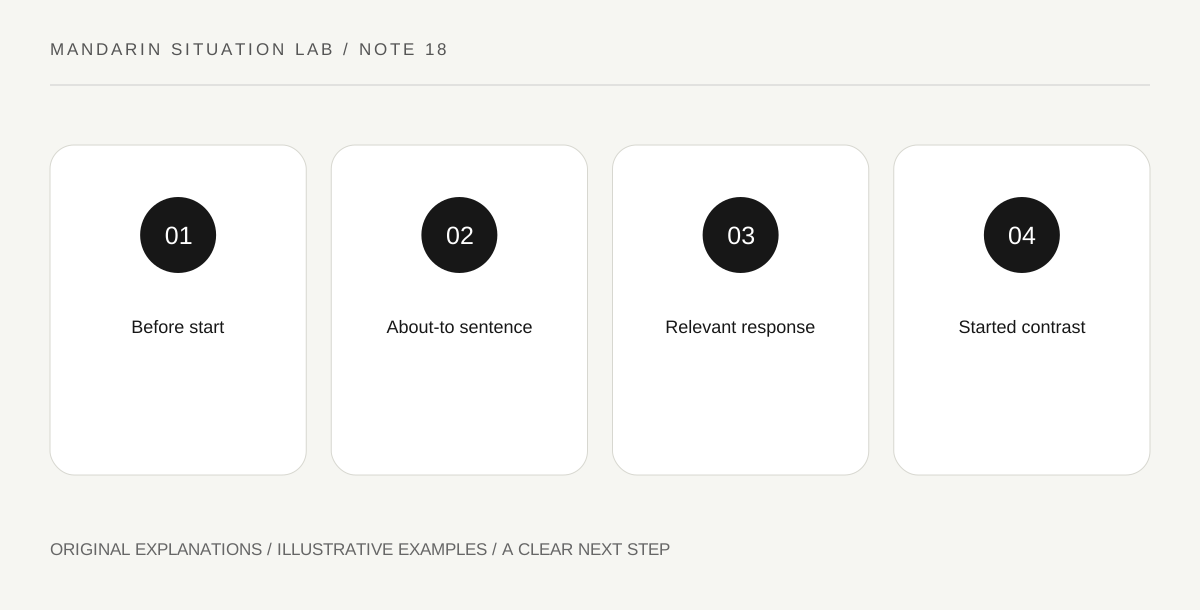
Original explanatory diagram. Read the full method and limitations below.
Place the event on a simple timeline
Draw three positions: before, in progress and finished. Put the fictional workshop just before the start point. 活动快要开始了。Huódòng kuài yào kāishǐ le. The activity is about to begin. The event has not started in this scenario. A learner who chooses the in-progress picture may recognize 开始 but miss the timing carried by the complete pattern. Keep the timeline visible for the first practice round.
Keep the pattern together
In this example, 快要 comes before 开始 and 了 appears at the end. Practise the whole sentence before trying to analyze every possible use of 要. The purpose is not to label all occurrences of the character with a single English word. Here the group of words expresses that an event is near. Read a reliable model aloud, then let a partner remove one card and ask you to restore the complete pattern.
Choose an appropriate next response
我们进去吧。Wǒmen jìnqù ba. Let us go inside. This response fits a fictional workshop that is about to begin in the next room. It would not necessarily fit a different context, such as an online event. Give your partner several response cards and ask them to choose one based on the setting, not merely on recognizing the word begin. Meaning includes the practical situation around the sentence.
Contrast the timing explicitly
活动开始了, huódòng kāishǐ le, can report that the activity has begun in the comparison scenario. Put it beside the about-to sentence and identify what changed on the timeline. You do not need to attach an exact countdown to every use of soon. In the final exercise, the partner hears one of the sentences and selects whether the event remains just ahead or has already crossed the start point.
Illustrative worked example
Illustrative activity: A fictional workshop is shown on three cards: people waiting outside, a presenter speaking and an empty room afterward. The learner receives the waiting card and says 活动快要开始了. The partner suggests 我们进去吧. In the next round, the presenter is already speaking, so the learner uses 活动开始了. Both explain which sentence leaves a short interval before the event and which places the start in the completed part of the timeline.
Questions that come up
Does 快要 give an exact time?
No. It expresses nearness in this context. If the exact start time matters, obtain or state that information separately instead of inventing a countdown.
Can I omit every part that seems repetitive?
Begin with the full practised pattern. Shorter variants exist, but omitting words at random can change or obscure the intended timing.
References and scope
These sources support the factual background. Examples and exercises are original illustrative teaching material. References do not imply endorsement.
- Mango Languages: Expressing be about to — Kuai yao and sentence-final le for imminent events.