Request a small adjustment with 一点儿
A small adjustment and a mildly negative description are related but different meanings. Practise placing 一点儿 after an adjective for a requested change, then compare it with 有点儿 before an adjective. A fictional volume or room example keeps the contrast concrete.
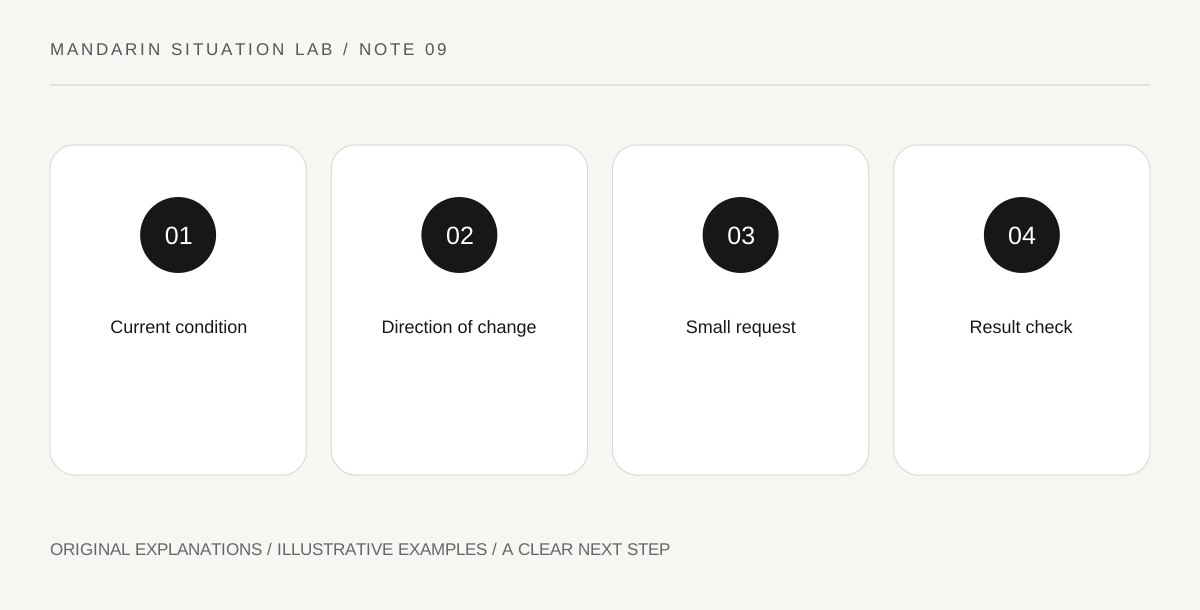
Original explanatory diagram. Read the full method and limitations below.
Describe the current impression
有点儿吵。Yǒudiǎnr chǎo. It is a little noisy. In this example, 有点儿 comes before the adjective and presents a degree of a condition, often with an unwelcome implication in this kind of sentence. The speaker describes the situation rather than specifying the desired change. Use a pretend sound setting on paper; there is no need to create actual uncomfortable noise for the exercise.
Ask for a direction of change
小声一点儿,可以吗?Xiǎoshēng yìdiǎnr, kěyǐ ma? Could you be a little quieter? The request asks for a smaller volume. The 一点儿 follows the descriptive expression in this pattern. Compare the arrows: the description marks where the volume seems to be, while the request points toward a change. This visible distinction can help you choose the sentence before you worry about every character in isolation. Move the paper marker only a small distance. This makes the degree phrase visible and keeps a request for a slight change distinct from turning the activity off entirely.
Try another harmless adjustment
慢一点儿, màn yìdiǎnr, means a little slower in a suitable request. 大一点儿, dà yìdiǎnr, means a little bigger. Use a partner’s drawing or reading speed in a consensual classroom task. Keep the change specific: slower, bigger or quieter. The practice should not become criticism of a person’s body, accent or personality. You are rehearsing a manageable adjustment to an activity or object that both people have agreed to discuss.
Respond after the adjustment happens
A partner can change the pretend setting and ask 这样可以吗?Zhèyàng kěyǐ ma? Is this okay? Answer according to the new card rather than saying yes automatically. You might say 可以,谢谢, kěyǐ, xièxie, yes, thank you. The complete exchange makes the request useful: the speaker describes a difficulty, asks for a small change and then confirms whether the change addressed the original problem.
Illustrative worked example
Illustrative role-play: A learner receives a card saying the fictional music is too loud. They say 有点儿吵 and ask 小声一点儿,可以吗? The partner moves a paper volume marker down one step and asks 这样可以吗? The learner checks the target marker and answers accordingly. In a second round, the activity changes to reading a sentence slightly more slowly, so the request becomes 慢一点儿 rather than a volume instruction.
Questions that come up
Does 有点儿 always mean a complaint?
No single shortcut covers every context. This lesson uses a common slightly unwelcome description to make the contrast with a requested adjustment easy to understand.
Must I pronounce 儿 separately?
No. 儿 can be realized differently across speakers and regions. Follow a reliable pronunciation model and keep the meaning clear rather than forcing an exaggerated extra syllable.
References and scope
These sources support the factual background. Examples and exercises are original illustrative teaching material. References do not imply endorsement.
- Mango Languages: Small quantity words — Yidian and youdian placement and meaning.