Recognize a simple prohibition before reading every character
Public notices often use compact wording that differs from a friendly conversation. Practise recognizing a prohibition marker and the action it concerns, then explain the instruction in plain English. This is a controlled reading exercise, not a substitute for understanding safety-critical or legal signs.
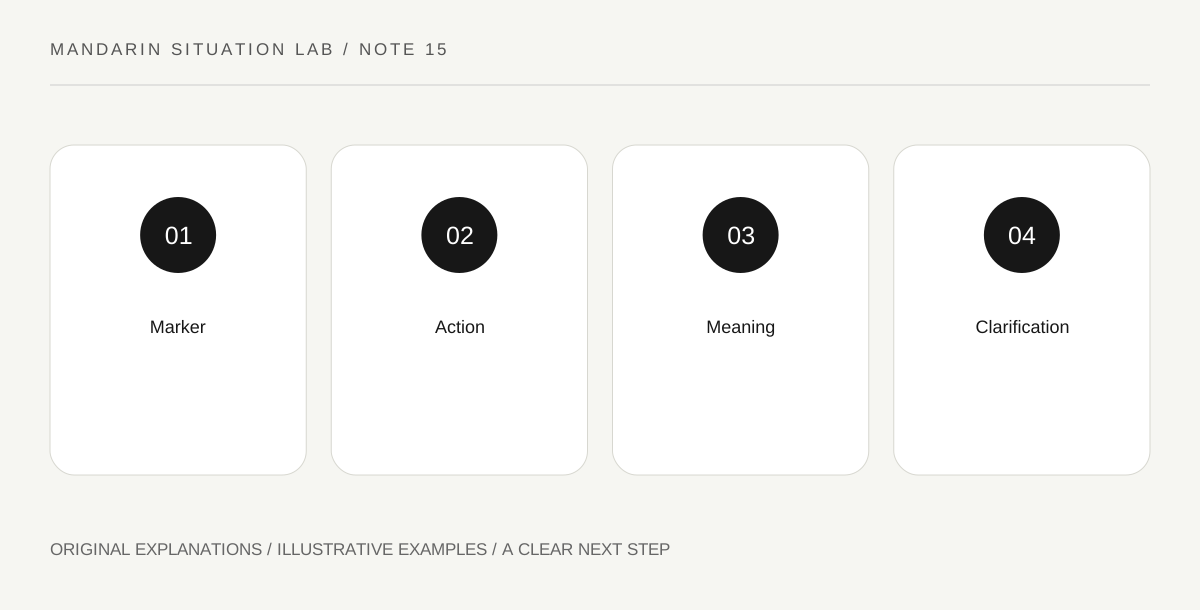
Original explanatory diagram. Read the full method and limitations below.
Find the instruction marker
请勿, qǐng wù, is a formal please do not pattern commonly found in notices. A practice card might read 请勿拍照, qǐng wù pāizhào, please do not take photographs. Identify the marker and action separately. You do not need to pretend that knowing one phrase lets you interpret every notice. When a real sign affects safety, access or legal obligations, obtain a reliable full explanation rather than guessing from one recognized character. Keep a separate unknown-sign pile visible throughout the exercise.
Separate the action from the object
拍照 names taking photographs in this phrase. Another fictional card can use 触摸, chùmō, touch, in 请勿触摸, please do not touch. Match each action to a picture before combining it with the prohibition marker. This helps prevent a learner from treating all signs with 请勿 as identical. The marker supplies the negative instruction, while the following action tells you what behavior the instruction addresses.
Compare the notice with spoken wording
请不要拍照, qǐng bú yào pāizhào, is a more conversational please do not take photographs pattern. The two expressions can serve a similar instruction in this narrow example, but they belong to different wording styles. Read them aloud with a reliable model rather than forcing a dramatic warning voice. The task is to recognize the instruction accurately, not to perform authority or argue about whether the fictional rule is desirable.
Practise an appropriate clarification
这里可以拍照吗?Zhèlǐ kěyǐ pāizhào ma? May I take photographs here? is a useful question when the permission is unclear. If an explicit applicable prohibition is already understood, the question is not a way to ignore it. In the exercise, the partner provides the fictional setting’s answer. Finish by sorting cards into permitted, prohibited or unclear, leaving unclear cards unresolved until the missing information is supplied.
Illustrative worked example
Illustrative card set: One card says 请勿拍照, another says 请勿触摸 and a third contains an unfamiliar instruction. The learner matches the first two to photography and touching pictures. They leave the third in the unclear pile rather than guessing. A partner then supplies the missing translation. In the speaking round, the learner asks 这里可以拍照吗 in a different fictional room where no notice has yet been provided.
Questions that come up
Does 请 make a prohibition optional?
No. It can make the wording polite, but the instruction still says not to perform the action in the stated context.
Should I translate every short sign literally?
Begin with the intended instruction, then study the wording. Compact notice language may not follow the same phrasing you would choose in a friendly conversation.
References and scope
These sources support the factual background. Examples and exercises are original illustrative teaching material. References do not imply endorsement.
- Mango Languages: Imperative sentences — Requests and prohibitions.
- Mango Languages: Expressing ability — Hui, neng and keyi distinctions.