Give the recipient a clear place in a Mandarin message
A short message about sending a photo needs a sender, a recipient and an object. Practise keeping those roles visible with 给. Then change one role at a time so you can tell whether your sentence still describes the transfer you intended.
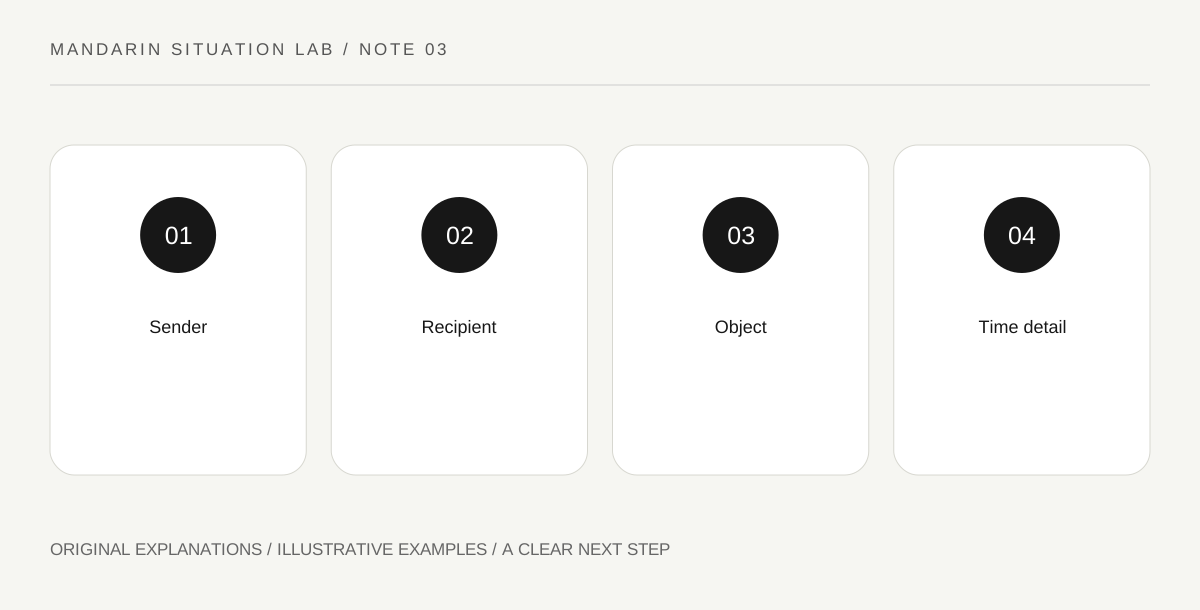
Original explanatory diagram. Read the full method and limitations below.
Build the message around a simple transfer
我给你发照片。Wǒ gěi nǐ fā zhàopiàn. I will send you photos. In this practice sentence, 我 identifies the sender, 给你 identifies the recipient and 发照片 names the action and object. Write those roles above the sentence. Drawing a small arrow from 我 to 你 can make the meaning clear before you try to say the line at a conversational pace.
Change the recipient without changing the sender
我给老师发照片。Wǒ gěi lǎoshī fā zhàopiàn. I will send photos to the teacher. The recipient changes, while the sender and object remain fixed. This controlled substitution is useful because a sentence can sound fluent while pointing to the wrong person. Have your partner choose a recipient card before each repetition, then ask them to point to the person who will receive the photos.
Change the requested action carefully
请给我发照片。Qǐng gěi wǒ fā zhàopiàn. Please send me photos. The speaker now asks someone else to act, and 我 is the recipient. Do not assume that the person mentioned first in your English translation must occupy the same role in every Mandarin sentence. Compare the two arrows on paper. The same people and object can appear while the direction and type of utterance change. Ask a listener to label sender and recipient after each sentence. If they reverse the arrow, rebuild the request slowly before adding any time information or another object.
Add only the detail the message needs
You might add 明天, míngtiān, tomorrow: 我明天给你发照片. The time belongs before the action in this sentence. Avoid combining an unfamiliar file name, a complicated date and several recipients on the first attempt. Once the basic message works, let the partner ask 谁给谁发照片?Who is sending photos to whom? Answering that question checks the roles more effectively than repeating the whole line from memory.
Illustrative worked example
Illustrative exchange: A classmate asks for pictures from a fictional craft activity. The learner says 我明天给你发照片. The partner summarizes that the learner will send the photos tomorrow. Next, the recipient card changes to 老师, so the learner produces 我明天给老师发照片. Finally, the task changes to requesting the pictures, and the learner says 请给我发照片. Three arrows show how the grammatical roles changed.
Questions that come up
Can 给 be a main verb?
Yes, 给 can also mean give. This lesson focuses on the recipient phrase inside a sending message, so keep that construction distinct while practising.
Do I always need to say 我?
Context can make subjects clear in conversation. State the roles explicitly at first, then practise a shorter message only after your partner can recover the intended meaning.
References and scope
These sources support the factual background. Examples and exercises are original illustrative teaching material. References do not imply endorsement.
- Mango Languages: Using gei — Recipient and giving constructions.