Plan another attempt with 再
A second attempt has not happened yet when you propose it. Practise 再 with a future repetition, then connect it to a useful change in the next attempt. The examples concern harmless classroom tasks, so the exercise can include a real decision to stop or continue.
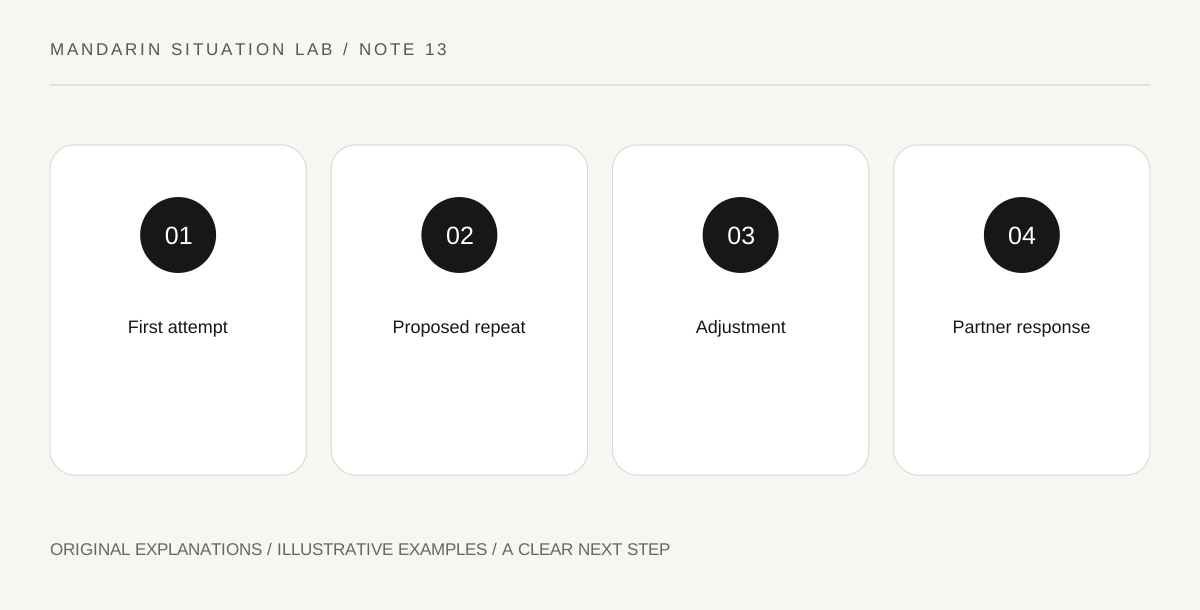
Original explanatory diagram. Read the full method and limitations below.
Name the action to repeat
我们再试一次吧。Wǒmen zài shì yí cì ba. Let us try one more time. 再 comes before 试 in this example, and 一次 counts one attempt. The sentence proposes another action rather than reporting a previous repeat. Keep a completed-attempt card on the table and place the proposed attempt beside it. This visible sequence makes the prospective meaning easier to grasp than a translation list alone.
Add a meaningful adjustment
这次慢一点儿。Zhè cì màn yìdiǎnr. This time, a little slower. A second attempt can practise a particular change, such as reading more slowly or using a clearer drawing. Repeating without a focus may still be useful, but the exercise becomes easier to assess when you know what you are changing. Have your partner choose one adjustment, then explain the difference between the first and proposed second attempt in simple English.
Let the listener respond
好, hǎo, can accept the suggestion in context. A learner can also ask to pause: 等一下, děng yíxià, wait a moment. Do not treat the suggestion as a command that must receive agreement. In a practice pair, the listener should have a choice card so the proposer must adapt to the answer. This turns a memorized sentence into a small conversation involving another person’s readiness and preference.
Change the action after the pattern works
我明天再看, wǒ míngtiān zài kàn, I will look or read again tomorrow, uses the same prospective repetition with a different action and time. The context identifies what will be looked at. Avoid building a long sentence with several new verbs immediately. First show that you can distinguish a proposed later repeat from a report that something already happened again. Then add the specific object or time the situation needs.
Illustrative worked example
Illustrative activity: Two learners attempt to read a short fictional sign. One says 我们再试一次吧. The partner agrees and asks for a slower pace with 这次慢一点儿. They try again and compare the second reading with the first. In the next round, the listener chooses to pause, so the proposer acknowledges 等一下 instead of beginning immediately. Finally, the pair changes the task from reading a sign to reviewing a drawing tomorrow.
Questions that come up
Is 再 pronounced the same as 在?
Yes, both are pronounced zài in standard Mandarin, but their meanings and written characters differ. Keep the word inside its sentence to distinguish the function.
Does another attempt guarantee improvement?
No. This is a language-practice proposal. Choose a focused adjustment and observe what happens rather than treating repetition as a promise of a particular result.
References and scope
These sources support the factual background. Examples and exercises are original illustrative teaching material. References do not imply endorsement.
- Mango Languages: Using zai for again — Prospective repetition with zai.
- Mango Languages: Small quantity words — Yidian and youdian placement and meaning.