Explain a destination and its purpose in one short plan
Going somewhere and doing something there can form one useful Mandarin plan. Practise a movement verb followed by the destination and purpose, then distinguish this relationship from two unrelated actions. The examples use fictional errands rather than real business opening hours or travel directions.
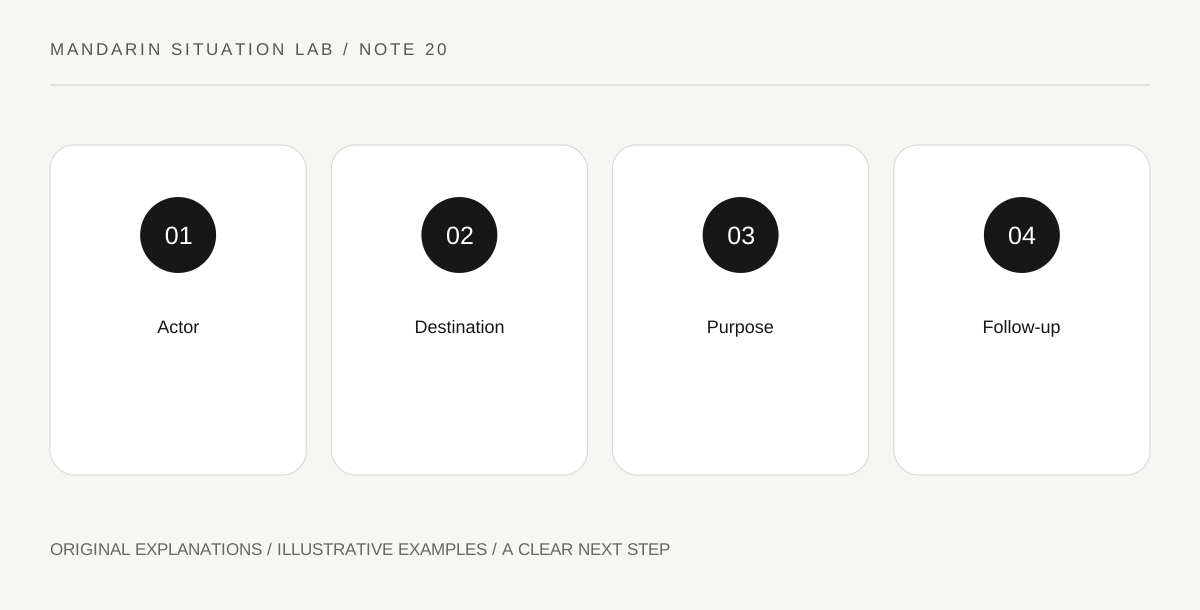
Original explanatory diagram. Read the full method and limitations below.
Choose a destination with a plausible purpose
我去书店买词典。Wǒ qù shūdiàn mǎi cídiǎn. I am going to the bookshop to buy a dictionary. The second action explains the purpose of going there. Before speaking, match the destination card with a reasonable activity card. A bookshop and dictionary form a clear pair in the exercise. A mismatched activity might be grammatically possible in a special story, but it would need more context to make the purpose understandable.
Keep the action sequence under one actor
我 remains the person who goes and buys in this short sentence. Do not silently change the buyer halfway through the plan. Draw one character moving toward the destination and then carrying out the purpose there. This distinguishes the example from a sentence in which one person travels while someone else does the task. If the scenario changes actors, use more explicit language instead of relying on a pattern meant for a shared subject.
Avoid adding 和 mechanically
The purpose relationship does not require placing 和 between 去书店 and 买词典. English may use go and buy in casual wording, but Mandarin need not reproduce that conjunction word for word. Learn the whole short plan, then ask what the second action contributes: it explains why the person goes to that destination. That meaning check helps distinguish a serial-action purpose from a simple list of independent activities.
Ask a follow-up about the purpose
你去书店做什么?Nǐ qù shūdiàn zuò shénme? What are you going to the bookshop to do? The learner answers 买词典, mǎi cídiǎn, buy a dictionary, or repeats the complete plan. A partner can then change only the destination or purpose card, forcing you to notice whether the pair still makes sense. End by stating the destination and task separately in English, then reconstruct the Mandarin without copying English word order.
Illustrative worked example
Illustrative card exercise: A learner receives the bookshop card and the dictionary card. They say 我去书店买词典. The partner asks what the person will do there, and the learner answers 买词典. Next, the dictionary card changes to a storybook, requiring a new object while the sentence structure stays available. A final mismatched pair prompts a clarification instead of a confident sentence that ignores the scenario. The task ends with an accurate destination-purpose match.
Questions that come up
Does 去 always mean a distant journey?
No. It can describe going to a nearby place. This exercise concerns the relationship between the movement and its purpose, not the journey’s distance.
Can I answer with only the purpose phrase?
Yes, when the question establishes the destination. Practise both a short answer and the full plan so you can adjust to the listener’s context.
References and scope
These sources support the factual background. Examples and exercises are original illustrative teaching material. References do not imply endorsement.
- Mango Languages: Serial verb constructions — Shared-subject actions and destination-purpose constructions.
- Mango Languages: Ways to say and — Different connections for nouns and actions.