Describe a new situation with sentence-final 了
The character 了 does more than refer to a completed action. In a short observation, it can show that a situation has changed. Practise connecting a before picture and a now picture, then explaining what changed without translating every 了 as an English past tense.
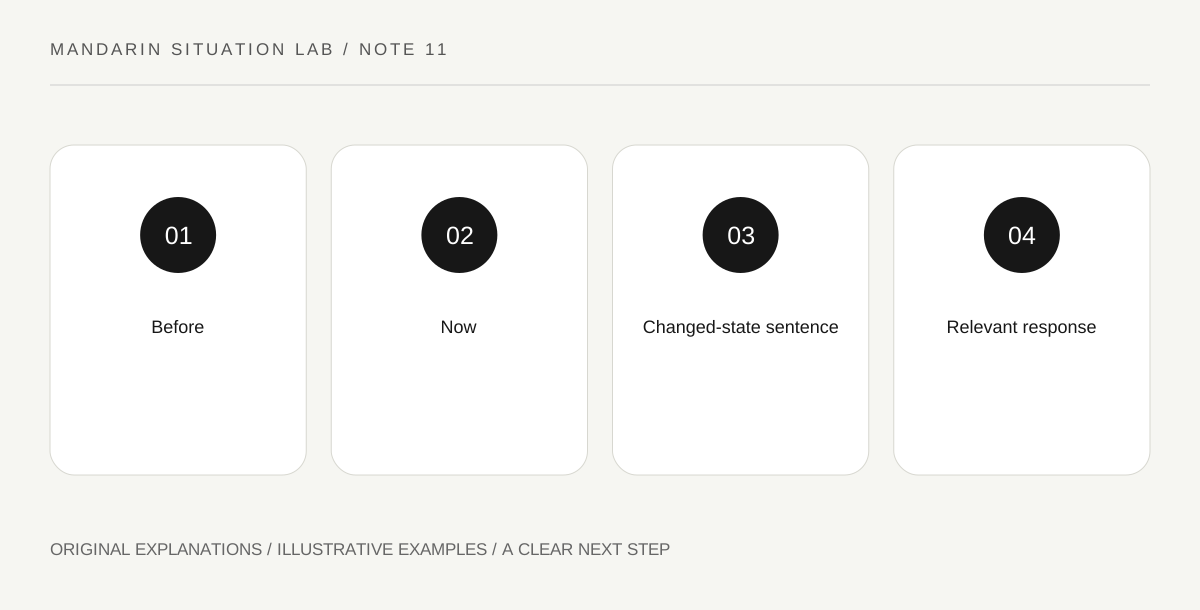
Original explanatory diagram. Read the full method and limitations below.
Start with two contrasting pictures
One picture shows a quiet room, and another shows the same room after visitors arrive. 安静了, ānjìng le, would describe becoming quiet in an appropriate context, so it would not fit this direction of change. Choose the sentence only after examining what the pictures actually show. A before-and-now task keeps meaning in control and prevents the particle from becoming an automatic decoration attached to every short statement.
Use a clear change in the example
下雨了。Xià yǔ le. It has started raining, or It is raining now, in this context. The fictional before picture shows no rain; the now picture shows rain. The 了 at the end presents a new situation. You are not simply reporting a finished rain event from last week. Say the sentence while moving from the first picture to the second, then have a partner identify which picture is current.
Try a change in personal readiness
我会打字了。Wǒ huì dǎzì le. I can type now, in a context where the skill has newly been acquired. The sentence combines a learned ability with a changed situation. The learner’s fictional character previously needed help and can now perform the task. Do not claim that saying the sentence proves a real skill or that one practice lesson guarantees mastery. The example describes the character card, not an assessment result.
Ask what the new situation changes
A simple follow-up might be 我们进去吧, wǒmen jìnqù ba, let us go inside, after the rain observation in a pretend outing. The follow-up gives the observation a conversational purpose. In the exercise, your partner chooses a relevant response from several cards. A response about a completely different topic signals that they may have recognized familiar sounds without understanding the new situation. Repeat with a fresh before-and-now pair.
Illustrative worked example
Illustrative sequence: A worksheet first shows people sitting outdoors under clear skies, then the same people under raindrops. The learner says 下雨了. The partner chooses a card suggesting going inside rather than one suggesting opening a book. A second sequence shows a fictional character who could not type before but can now type a short message. The learner says 我会打字了 and explains in English what changed between the pictures.
Questions that come up
Does every sentence-final 了 mean a change?
This is one important use, but 了 has several functions. Learn this narrow contrast before trying to classify every example from conversation.
Can a changed situation concern the present?
Yes. The new state may hold now, as in the rain example. That is why automatically translating the particle as a past-tense ending can mislead you.
References and scope
These sources support the factual background. Examples and exercises are original illustrative teaching material. References do not imply endorsement.
- Mango Languages: Using sentence-final le for changed situations — Changed situations with sentence-final le.