Connect a reason and an outcome with 因为 and 所以
A simple explanation can show what caused a change in a plan. Practise a reason clause and an outcome clause, then check that the relationship makes sense. The exercise uses fictional classroom arrangements so you can focus on meaning rather than on defending a real decision.
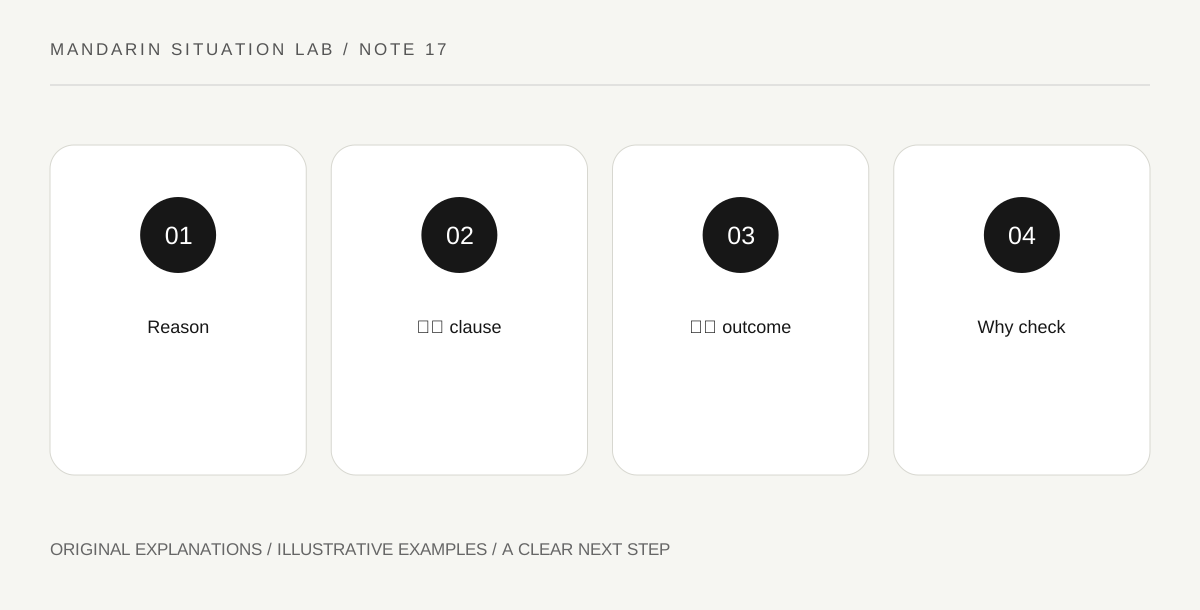
Original explanatory diagram. Read the full method and limitations below.
Choose a cause with a visible effect
Imagine that a practice room is already occupied, so a group uses another room. The reason and outcome belong together. Do not combine two unrelated facts merely because you know the connecting words. Before speaking Mandarin, describe the relationship in English: the first fact explains why the second action happened. A partner can reject a mismatched cause-and-outcome card, giving the sentence a meaning check as well as a grammar check.
Put the reason after 因为
因为教室有人, yīnwèi jiàoshì yǒu rén, because there are people in the classroom, supplies the reason in this fictional scenario. Keep 因为 attached to the reason rather than the outcome. You can practise the clause by itself while arranging cards, but a complete explanation needs a main outcome as well. The exercise should not leave a listener waiting indefinitely for what happened because of that condition.
Introduce the outcome with 所以
所以我们去图书馆, suǒyǐ wǒmen qù túshūguǎn, so we are going to the library, gives the consequence in this practice plan. Together, 因为教室有人,所以我们去图书馆 explains the change. English often chooses either because or so in a single sentence, while this Mandarin pattern can use the pair. Avoid applying an English editing rule mechanically to the Mandarin example; learn the complete cause-and-outcome pattern in its own context.
Test the explanation by asking why
A partner asks 为什么去图书馆?Wèishénme qù túshūguǎn? Why go to the library? You respond with the reason rather than repeating the outcome. Then have the partner state what the group will do. These two questions test both sides of the relationship. Once the basic example is clear, replace the reason and destination with another plausible fictional pair while preserving the same logical connection. The answer should identify a cause, not merely repeat the destination.
Illustrative worked example
Illustrative card task: A classroom card shows an occupied room. A library card shows the group’s alternative destination. The learner says 因为教室有人,所以我们去图书馆. The partner asks why and receives the occupied-room explanation. Next, an unrelated card about a red notebook is offered as the reason. The learner rejects it because it does not explain the destination change, then rebuilds the sentence with a matching cause.
Questions that come up
Must every Mandarin reason sentence use both words?
No. Mandarin offers several ways to express reasons. This lesson practises one complete paired pattern so that the relationship is easy to see.
Can I copy English because-so wording directly?
Use the Mandarin pattern on its own terms. English and Mandarin do not always package the same relationship with the same number or position of conjunctions.
References and scope
These sources support the factual background. Examples and exercises are original illustrative teaching material. References do not imply endorsement.
- Mango Languages: Reasons and purposes — Cause and outcome patterns with yinwei and suoyi.