Choose the red one without repeating the object name
Once two speakers know the object category, a short descriptive phrase can identify one item without repeating its noun. Practise the red one and the blue one in a controlled card task, while keeping enough shared context for the shorter phrase to make sense.
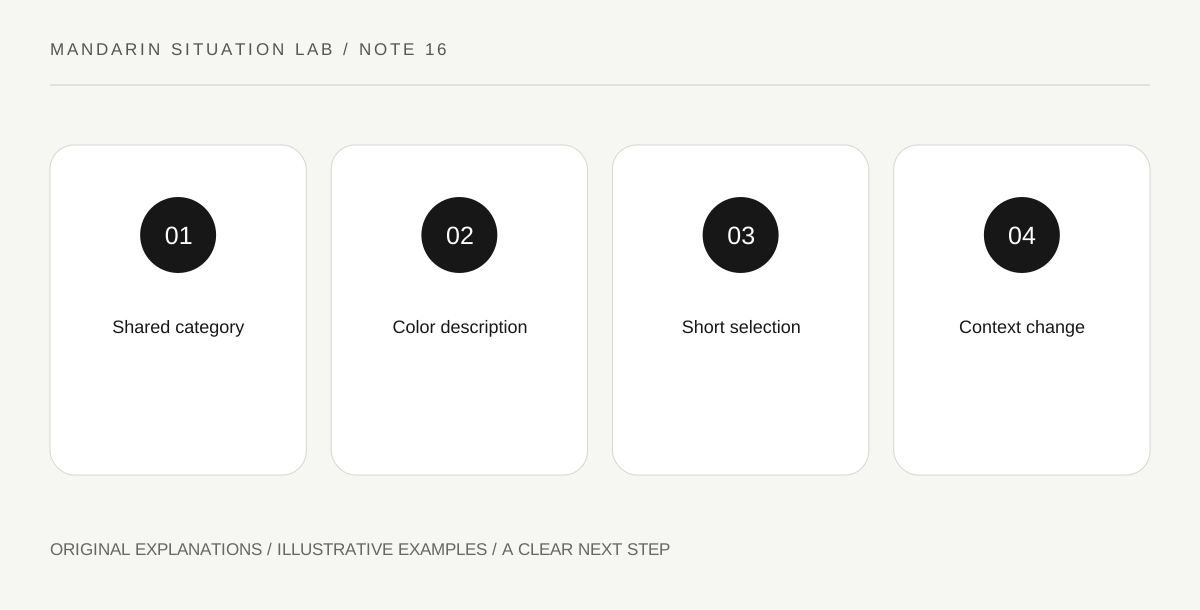
Original explanatory diagram. Read the full method and limitations below.
Establish what the objects are
The worksheet shows several notebooks. Begin with 我想要一本笔记本, wǒ xiǎng yào yì běn bǐjìběn, I would like a notebook. Both speakers now know the object category. Without that shared information, a bare red one may refer to a bag, a cup or something else. The first round should state the noun explicitly so that the shorter phrase later has a clear item to recover.
Keep 的 after the description
我要红色的。Wǒ yào hóngsè de. I would like the red one. In this context, 红色的 identifies the red notebook without repeating 笔记本. Do not drop 的 from this shortened phrase merely because the noun has disappeared. The phrase is doing a different job from an isolated color word. Say the full version 红色的笔记本 once, then compare the shorter version while pointing to the same object.
Ask a matching choice question
你要哪个?Nǐ yào nǎ ge? Which one would you like? The partner answers according to a hidden color card. After hearing 我要蓝色的, wǒ yào lánsè de, I would like the blue one, the listener selects the matching notebook. Use only two or three colors initially. A small set makes it easy to see whether the description worked without making vocabulary recall the main difficulty.
Restore the noun when context changes
If a new picture introduces cups as well as notebooks, the red one may no longer be enough. Repeat the noun or add another identifying detail. This is a communication decision, not a requirement to make every sentence longer. Your partner should be able to explain when the short phrase was clear and when it became ambiguous. Practise adding the noun back naturally instead of treating shorter speech as automatically more fluent. Ask which object the listener selected and why.
Illustrative worked example
Illustrative selection task: Two notebook pictures, one red and one blue, appear on a table. A learner establishes that they want a notebook, then answers 哪个 with 我要红色的. The partner selects the red notebook. In the next round, a red cup appears too. The learner now restores 笔记本 in the description so the partner does not choose the cup. The task demonstrates why noun omission depends on a recoverable shared category.
Questions that come up
Does 的 always mean possession?
No. It also connects descriptive material with an item. In 红色的, the item is understood from context rather than stated again.
Is a shorter answer always better?
No. A short phrase works when the listener can identify the omitted item. If the context is ambiguous, repeating the noun makes the sentence more useful.
References and scope
These sources support the factual background. Examples and exercises are original illustrative teaching material. References do not imply endorsement.
- Mango Languages: Structural de — Possession, modifiers and recoverable omitted nouns.
- Mango Languages: Demonstrative words — This, that and selection phrases.