Choose a word for skill, possibility or permission
English can covers several meanings that Mandarin often separates. A person may know how to do something, be able to do it today or have permission to do it here. Practise choosing the intended meaning before selecting a familiar Mandarin word.
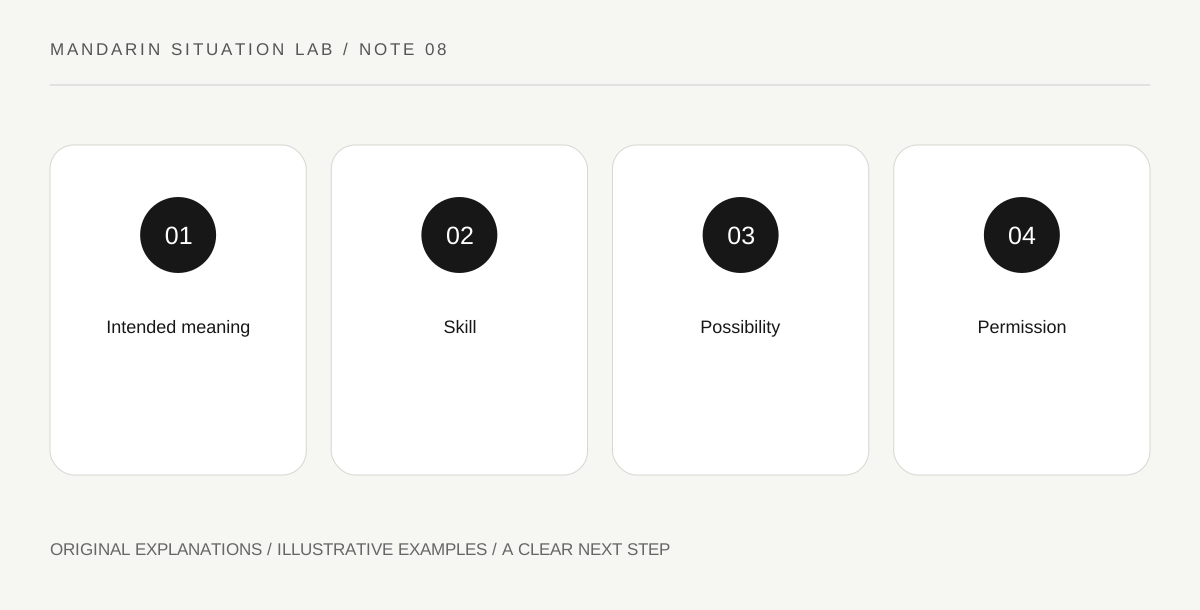
Original explanatory diagram. Read the full method and limitations below.
Ask whether a skill has been learned
我会游泳。Wǒ huì yóuyǒng. I know how to swim. In this example, 会 presents a learned skill. The lesson is about language, so practise with pictures or fictional characters rather than using a sentence as evidence of anyone’s real competence. Other harmless classroom examples include typing or playing an instrument. Ask what the person knows how to do, not whether a particular activity is appropriate today.
Describe practical possibility separately
我今天不能来。Wǒ jīntiān bù néng lái. I cannot come today. The fictional person may know perfectly well how to travel to the meeting; something prevents attendance. 能 concerns ability or possibility in this context. Place a schedule conflict beside the character card so the meaning stays visible. Do not translate the sentence as a claim that the person has never learned the skill of coming to a meeting.
Ask permission in the setting
我可以坐这里吗?Wǒ kěyǐ zuò zhèlǐ ma? May I sit here? This request concerns whether the seat is available or permitted in the situation, rather than whether the speaker learned sitting as a skill. In the role-play, the partner can accept or explain that the seat is reserved in the fictional room. The answer must remain open, because asking permission is different from announcing that you intend to act regardless.
Sort meanings before producing sentences
Create three headings: learned skill, practical possibility and permission. Put a short English scenario under each heading, then choose a Mandarin sentence. Some words overlap in real usage, so this is a useful beginner contrast rather than an absolute rule covering every sentence. When two choices seem plausible, explain the intended meaning and consult a reliable model. Keep the situation clear instead of declaring that English can always has one correct Mandarin equivalent.
Illustrative worked example
Illustrative card set: A musician has learned piano, a volunteer cannot attend a fictional meeting today and a visitor wants to use an empty chair. The learner matches 会 to the learned skill, 不能来 to the attendance obstacle and 可以坐这里吗 to the permission question. A partner changes one scenario: the visitor now knows the chair is reserved. The learner explains why a permission question requires an answer rather than assuming availability.
Questions that come up
Are 会, 能 and 可以 completely separate?
No. Their uses can overlap and depend on context. This exercise establishes three common meanings through narrow examples rather than claiming a universal one-to-one mapping.
Can I practise without swimming vocabulary?
Yes. Use familiar learned activities such as typing or drawing. The grammatical contrast matters more than memorizing a difficult action word in the first round.
References and scope
These sources support the factual background. Examples and exercises are original illustrative teaching material. References do not imply endorsement.
- Mango Languages: Expressing ability — Hui, neng and keyi distinctions.